
Name: Greg Manley
Title/Occupation: Commissioner of the Circle Rules Federation
URL: Culturebot
 “Uugghh!”
  Emily Stone and Ursula Eagly remain unruffled, regal; one might say serene if not for the frank and focused intensity of their demeanor.
 and plucked off their long sleeved bodices with their teeth revealing the shapeliest breathing collection of breasts, torsos and backs I think I have ever seen.
 then vanish all into the wing pursued by audience applause.
 That score takes the form of a Requiem Mass sung in Breton, Middle French and Latin by the likes of half the cast of Anonymous 4 (Ruth Cunningham and Jacqueline Horner-Kwiatek) and 4 members of the acclaimed male a cappella vocal group Lionheart (Michael Wenger, John Olud, Lawrence Lipnik, and Kurt-Owen Richards.
 Joan Arnold, Alison Granucci, and Grazia Della Terza as the crones based on the ancient Greek Graeae
 Nakamura sidles in near the back of the stage at the audience’s right while the blue-lit Weinert, starting prone at our feet, probes gravity and his wall like caterpillar seeking a chrysalis hook. In their single stark moment of interaction the Japanese dancer helps his hapless partner find his sticking place by pinning him to the wall with a hand around the throat.
 Only had you picked up press material, consulted DNA’s web site, or had the time and sense to ask the choreographer or one of the dancers post-show, would you be likely to know that the ritual incarnates an imaginary version of the Buddhist segaki rite that concerns itself with personal atonement and easing the suffering of the wandering (slithering?) dead.
  standing (l to r): Jamie Graham, Rebecca Woll, Moses Kaplan, Alex Schell, Maggie Ronan, Jessica Thomas; seated (l):Penny Dannenberg. Photo by Eric Bandiero
 at rear: (l to r) Moses Kaplan, Jamie Graham, Maggie Ronan, Jackie Ferrara. front: Penny Dannenberg, Ani Javian. Photo by Eric Bandiero
 Add to this interplay the lusty way in which Goldberg Haas’ young professionals Jamie Graham, Ani Javian, M. Lindsay Smith and Rebecca Woll bite into the music and movement as if to both throw down a challenge and lead the way among their younger and older counterparts, and you have a work that begins to transform the creative potential energy of Dances For A Variable Population into a power to move and inspire its audience as much as its own members. In this, rehearsal director Smith, of the high-arched and articulate feet and whip-smart torso, and the equally fiery Graham set the tone as firsts among equals. With any luck, this cross-generational ensemble, including its new-found Tisch quartet, will manage to hold together long enough to re-present an outdoor version of this work at the end of September in cooperation with Hudson Guild Fulton Senior Center along the High Line Park in Chelsea.
 Mandarin Wu (with fan) Gierre J. Godley, and Monica Barbaro photo by Tony Dougherty
  Bill Shannon has gone ¾ of the way around the tip of Manhattan, retracing in retrograde the route famously described by the narrator Ishmael in the opening paragraphs of Moby-Dick. And, like his fellow traveler, he pauses to wax philosophical.
 “Sometimes,” he says, his nose finally flush with the pavement, “it can look like failure.”
 Three years in the making, Traffic’s metaphorically rich, imaginatively provocative and downright audacious adventurousness augurs well for the revitalizing Artist in Residence Program at DNA. Not to be missed, the 20 accompanying videos by the same artist that play along DNA’s gallery walls add another dimension to Shannon’s chess game with the laws of physics and those of Downtown Manhattan traffic.
 Jenny Rocha and her Painted Ladies have developed a following in this town since their debut in 2006. So has trumpeter, singer and bandleader Brian Newman. The two have each featured for some time now as performers in the intermittent Floating Kabarette productions of the Galapagos Art Space in DUMBO, and both, in at least a part of their individual oeuvres, exhibit an interest in reclaiming and revitalizing the production values and styles of a bygone era of swanky supper clubs and New York nightlife.
  Newman proved a genial host, except when beset by a recurring short in the microphone cord as he fondled his boxy 50’s style stand mic. Ahead of his polished side men -- Paul Francis on drums and Alex Smith on electronic keyboard -- he took the “pit,” what would normally serve as the audience left “pod” closest to the stage in Galapagos’ pool-bridging orchestra level seating scheme. Nattily tailored in a single-breasted dark suit complete with pocket square, a black pinstriped shirt with a white pointed collar and a white silk tie – Saville Row meets Bugsy Malone -- Newman welcomed the audience before turning his warm baritone, fiery trumpet and band mates loose on Irving Berlin’s “Puttin’ on the Ritz.” He then introduced his hosts: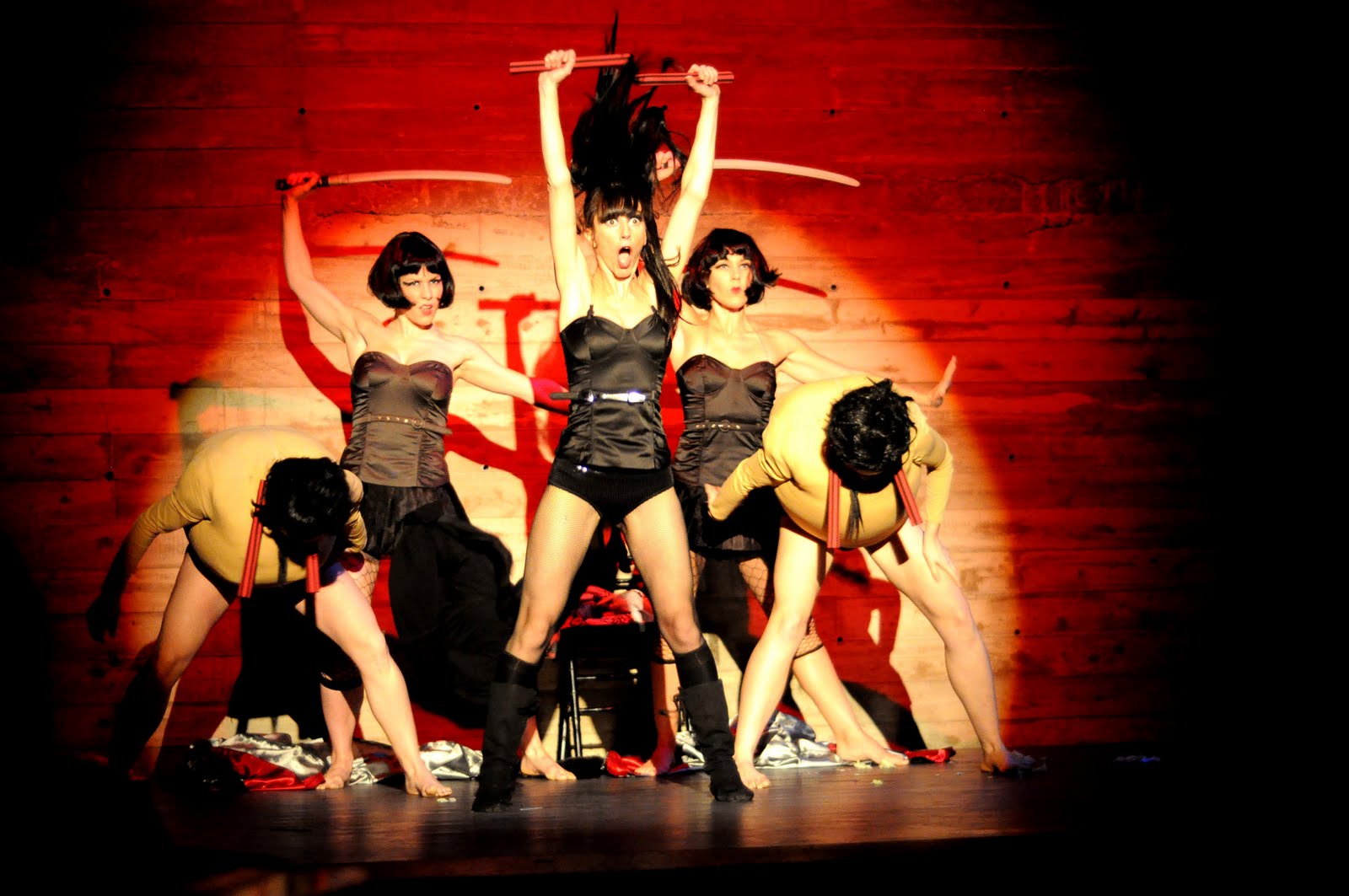
 photo by Dmitri Wildfong Nishman
 The audience has just been moved. Literally. The handsome couple, who have perched so exquisitely atop the coffee table placed against the mirror at the west wall of 100 Grand, find themselves momentarily separated when the musical chairs-like redistribution of spectators-in-the-round calls for us to claim new seats. But across the gap now between them, he beckons her to an adjoining empty chair. Their union restored, an open seat now offers itself next to me. Soon, Bill Young, the loft’s proprietor sidles into it.
 Hsaio-Jou Tang attached to Amber Morgan
  These two represent only the first among equals in distributing the simple gifts that Petroliunas flings around. Bodley has often featured in the choreographer’s canon, and her two solos here seem to build on and extend her role as muse-in-chief. (That’s mis-chief to you, buddy). Igarta, on the other hand, who also plays the loft’s piano to accompany Bodley’s first solo, breaks through as a master of the kind of weighted lyricism that has begun to emerge as a Petroliunas leitmotif.
 Meredith-Lyn Olivieri prepares her ziggurat
 “Grandma’s art work.”
 I did a lot of counting at the show of recent work that Swid shared with Donald Kaufman at 9E. I counted the disassembled books in Swid’s wall relief’s, framed assemblages building from materials similar to those of the the wall mounts, to foil-like assemblages of dark to brightly colored and clear cellophanes, leading finally to ones encrusted with gold leaf over index pages from manila legal files: N – O, or Z – X for instance.
 So says Michael Micalizzi as the thug wannabe Mikey in Patrick Shaw’s “Mad Twitterpated,” directed by Alexandra Bassett. He pleads this in reference to the orphaned bear cubs he has been cluster adopting over Facebook on behalf of Cliff Campbell’s character Clifford. But his observation goes far beyond its immediate context.
 So if Cliff and Mikey’s play within a play involves dream visualization projected via, uh, Droid, and ends with kids and a mortgage, their confusion cannot be considered uncommon. Consider the women in Lillian Meredith’s “there is no part of me that wants to have sex with you right now and yet here we are.” They confide in one another that they have never had an orgasm during sex, simulate coitus with their giant teddy bears, have trouble deciding whether they want it “hard” or “soft,” and rant about being insulated, via Midol, from the emotional roller coaster of their own natural cycles. They ponder existential and psycho-political questions around penetration:
 (l to r:) Laura Wiese, Lauren Weinberger, Sean McIntyre and Sarah Ann Masse
 The expectations and the etiquette of politically correct sex in an epoch of texting, drinking binges, supercharged sex toys, internet porn, post-feminist and post-Freudian politics, and pop psychology emerge as preoccupations in Brian Hashimoto’s “porn.edu,” and Bassett’s “Lust Trust,” directed by David Jaffe. The latter two of these themes also crop up with less contemporary reference as kinky Viennese proto-fascist subtexts in Benjamin Smolen’s “The Lewis Family Waltz,” directed by Shaw, with its dancing couples stuttering and undone over the name “Germany,” and Lucy Gillespie’s mock-historic “Fore-Shadow-Play.”
  To be sure, the allure of ambition and energy emerge as the hallmark of this long evening even if the short videos “Hobo Proposal” by Ironic T-Shirt, and the satirically sharper “Call My Boyfriend,” by Diana Wright, as well as the soul cover sets by the quartet Quiet Loudly might have been more imaginatively integrated to facilitate the flow of events and interactivity. Bassett and her collaborators sometimes betray a literary and theatrical reverence that smells more of the perfume of a fine liberal arts education than it does of teen spirit, but the strength of their cooperative rests in a sense of shared adventure and risk. The more they continue to challenge each other, and to raise their realization to the level of their ambition, the more Fullstop will distinguish itself as a collective not only worth watching, but dating long term.
 The first of the images happens to be one of the late Karlheinz Weinberger’s gelatin silver prints, a set of which took up an entire large wall in the first interior gallery. Titled Männlicher Akt, the image in question dates from around 1975, and depicts a somewhat hairy 20’s something male nude, glancing offhandedly towards the camera/viewer. His tattooed arms and hands frame a slouched torso and his flaccid, ample cock and balls rest within the V of his thighs, which spread to straddle the platform, covered with a striped fabric, on which he sits.
 “Denim’s cult status as a rebel uniform emerged in the public mind largely through classic Hollywood cinema—for instance, Marlon Brando in The Wild One, James Dean in Rebel Without a Cause, and Marilyn Monroe in The Misfits, and later as the preferred style for certain subcultures, for example gay subculture, as can be seen in Kenneth Anger’s Scorpio Rising and Kustom Kar Kommandos; or, returning to Hollywood, William Friedkin’s controversial Cruising.
 A concern with fashion, in fact, both actual and artistic/cultural, lay just below the surface in this runway of art featuring work in many media from 11 artists and ranging over the last half century. That would place the work in response to the “emergence” referenced in the press release, but squarely inside the “ingraining.” Said to have been originally inspired in part by the guns prominent in the Export performance artist’s work of the late 60’ and 70’s, the show veered instead towards the spectacle of artists’ depictions of our meta erotic fascination with what we wear and how we let it represent us. Thus we have Valie Export's gelatin silver image Genital Panic, 1969, from the Action Pants series, in which she has photographed herself with her crotch partially exposed while holding a rifle – a proto Patty Hearst.
 The first hint of whimsy arrives in the form of the riot of old fashioned table lamps, complete with shades, hung upside down from the ceiling and replacing the normal lighting in the main dance space of the second floor loft at 100 Grand St. in Manhattan. Chairs for the audience have been ranged along the windowed wall overlooking the eponymous street, and at a ¾ angle in the loft’s southeastern corner. Facing this latter quadrant after the lights dim and then resume their warm glow Peter Chamberlin begins “19/20,” a 6 minute solo that sets the tone for an engaging evening of dance exploration.
 “Untitled” pairs the radiant and articulate Shayla-Vie Jenkins with the coolly articulate Hsiao–Jou Tang in patterns that go from head and shoulders to feet in poses and walks shot through with swift silent and limber side falls and rises. The dancers provide such a visual and kinetic feast in the robust suppleness of their realization of Chamberlin’s choreography that even the simple crisp change of a walking pattern from vertical to horizontal orientation across the stage registers with the force of revelation. Like the dancemaker, these women make maximum use of their fabulous feet.
 The six dancers, 4 in white dresses or skirts, 2 in white pants and shirts stand in the space facing in several directions. First 3, and then 2 more fall into motion as Saul Simon MacWilliams' recorded score brings the opus “goose” to life. Throughout the first musical segment, Lesley Garrison stands her ground while Sarah Bodley, Tess Igarta, Tang, Julia Burrer, and Chamberlin fly through a series of backwards, forwards and side runs and falls, turns, and twists in patterns that remind me of choreographic palindromes.
 The dancing progresses with a steady and formal attention to its compositional development. Figures I recall from earlier work come and go in lines of dancers, designs for soloists, duets, trios, ensembles. Bodley, Burrer and Tang mount the fire escape and “release” the origami cranes from their string. Garrison pulls individual members of the audience out to shadow the dancers original positions onstage. Each time she finds herself hurled aside and displaced by another dancer. When all the doppelgangers have taken their place, she can rest at last, secure in her own. The "goose" comes home.
 “Fucking Paki driving instructor!”
  “Seatbelt,” Ranit reminds her.
 Siddiqui imbues Ranit with a convincing sense of moral myopia inside a physical presence that suggests a full communion with his character’s body. When he lays his arm along the seat behind his charge’s back he creates a vague sense of casual creepiness only heightened by his character’s apparent lack of awareness of, or concern with, boundaries.


